Oysterband Biography
(1) This is what the individual bandits see fit to
print about themselves (though their
partners/children/bank-managers/dogs might see it
differently). Not to be taken too seriously....
John
Jones: vocal, melodeon
Alan
Prosser: guitars, vocal
Ian
Telfer: violin, keyboard, concertina, vocal
Al Scott: bass, mandolin, vocal
Adrian Oxaal: cello, vocal
Sean Randle: drums
See below for:
(2) the polite official version
(3) a micro-version
and
(4) an outside view
(1) The Individuals
IAN TELFER
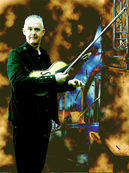 Born in Falkirk, a
place he has revisited just once, on a wet Wednesday (and
it was closed). Each male generation of his father's
family either worked in a bank or went to sea, which might
explain a few things if you believe in genetics as
destiny. Grew up in Aberdeen, and in more egalitarian
days, when such things were easier (hooray), was the first
in his family to go to university, studying Lang'n'Lit at
Aberdeen, which he loved, and at Kent at Canterbury, which
he did not. Flunked out of an attempted doctorate (the
words "George Meredith" can still bring him out in hives)
and dossed around as waiter, bartender, overeducated
skinhead until "Music saved my life!" Was the fiddler in
artfolk band Fiddler's Dram (with Alan and others) until
they had a huge novelty-hit single, "Day Trip To Bangor".
Fiddler's Dram did one more tour then gratefully took the
money and the gold discs and ran, in Ian's and Alan's case
into what was then an aspiring dance outfit, The Oyster
Ceilidh Band……
Born in Falkirk, a
place he has revisited just once, on a wet Wednesday (and
it was closed). Each male generation of his father's
family either worked in a bank or went to sea, which might
explain a few things if you believe in genetics as
destiny. Grew up in Aberdeen, and in more egalitarian
days, when such things were easier (hooray), was the first
in his family to go to university, studying Lang'n'Lit at
Aberdeen, which he loved, and at Kent at Canterbury, which
he did not. Flunked out of an attempted doctorate (the
words "George Meredith" can still bring him out in hives)
and dossed around as waiter, bartender, overeducated
skinhead until "Music saved my life!" Was the fiddler in
artfolk band Fiddler's Dram (with Alan and others) until
they had a huge novelty-hit single, "Day Trip To Bangor".
Fiddler's Dram did one more tour then gratefully took the
money and the gold discs and ran, in Ian's and Alan's case
into what was then an aspiring dance outfit, The Oyster
Ceilidh Band……
Writes much of the band's output of lyrics, generally in consultation with John. Has been banned, er, democratically outvoted by other Oysters from playing sax on stage. Until recently lived in a Cypriot/Kurdish village in north London, where his immediate neighbours were Jamaican, Pakistani, Somali, Greek Cypriot, Chinese and South American, and he liked it very much, thanks, apart from the police helicopters at night. Has now relocated to a village north-east of London. Currently into: North Africa, Iran, Turkey; the poems of C D Wright and of Michael Donaghy; and the novels of Orhan Pamuk; though none of these are likely to have an influence on future song-writing.
ALAN PROSSER
 Upbringing: totally
normal, except for driving parents and siblings demento
with whistles, recorders, banging on the piano, etc. They
did not deserve this. Early groups (savour the period
charm of some of these names): The Clee Three; Madame
John; Cuspidor; Beggar's Description; Fiddler's Dram… also
a stint with Albion Band. Instruments tried: guitars,
fiddle, mandolin, banjo, bowed psaltery, bones, bandura,
various guitar synths, sitar, drums (failed), trumpet
(failed failed), banjo-mandolin (eeyuk!)… Alan says: "I
dropped out of Kent University to become a medieval
minstrel and pizza chef, though not usually at the same
time. Invented the banana-flavoured bolognese sauce for
spaghetti, which remains a signature dish in the sense
that no one else on the planet will touch it with a
bargepole. Got heavily into the guitar; in fact got so far
into the guitar that once when Ian was wittering about
recent events I had to say: "General election? What
general election?" - which I have not been allowed to
forget. Found myself in The Oyster Ceilidh Band and the
rest you know. Married Jane Elder in 1988, one son Harry
born September '93. Made two solo albums, Hall Place
(1997) and Makerfield (2003), and a trio album Nomads
(2006) with Brendan Power and Lucy Randall.
Upbringing: totally
normal, except for driving parents and siblings demento
with whistles, recorders, banging on the piano, etc. They
did not deserve this. Early groups (savour the period
charm of some of these names): The Clee Three; Madame
John; Cuspidor; Beggar's Description; Fiddler's Dram… also
a stint with Albion Band. Instruments tried: guitars,
fiddle, mandolin, banjo, bowed psaltery, bones, bandura,
various guitar synths, sitar, drums (failed), trumpet
(failed failed), banjo-mandolin (eeyuk!)… Alan says: "I
dropped out of Kent University to become a medieval
minstrel and pizza chef, though not usually at the same
time. Invented the banana-flavoured bolognese sauce for
spaghetti, which remains a signature dish in the sense
that no one else on the planet will touch it with a
bargepole. Got heavily into the guitar; in fact got so far
into the guitar that once when Ian was wittering about
recent events I had to say: "General election? What
general election?" - which I have not been allowed to
forget. Found myself in The Oyster Ceilidh Band and the
rest you know. Married Jane Elder in 1988, one son Harry
born September '93. Made two solo albums, Hall Place
(1997) and Makerfield (2003), and a trio album Nomads
(2006) with Brendan Power and Lucy Randall.
JOHN JONES
 Born in Aberystwyth,
Wales, and brought up in Meltham, Yorks. Dad rarely spoke
Welsh, maybe because they called him Taffy, which he
hated. Mum's family came from Castleford and had a
coal-mining background. Parents were Labour supporters,
grandparents were Communists, so there was no shortage of
political argument in the house. My grandad, Edward
Longley ("Red Ted"), was the greatest influence on my life
when young. From him I got radical politics, the sense of
injustice, al love of nature, a love of lurchers, hatred
of the Tory way of mind, the sense of history, and a short
temper.
Born in Aberystwyth,
Wales, and brought up in Meltham, Yorks. Dad rarely spoke
Welsh, maybe because they called him Taffy, which he
hated. Mum's family came from Castleford and had a
coal-mining background. Parents were Labour supporters,
grandparents were Communists, so there was no shortage of
political argument in the house. My grandad, Edward
Longley ("Red Ted"), was the greatest influence on my life
when young. From him I got radical politics, the sense of
injustice, al love of nature, a love of lurchers, hatred
of the Tory way of mind, the sense of history, and a short
temper.
Went to grammar school; was made aware of what selection in schools does to people. Survived school thanks to good teachers and was the first of my family to get to university. After football, music was my big love, particularly Northern Soul. Became the first mod in Meltham. Learned piano, thankfully.
Went to Exeter University: a revelation, it was so middle-class. Took Politics and Sociology (people did in those days). Fell in love with British traditional music and all things English - learned melodeon, morris-danced, wore collarless shirts, and generally tried my best to become an old man before my time. Arrived in Canterbury, Kent, via London, and met afro-haired, bespectacled guitarist and severe short-haired Scottish fiddle-player (among many others in a truly amazing local music scene). Was an English teacher for some time and became a year-head in Canterbury's only comprehensive school. I was a lazy teacher but a good year-head - I think.
Helped form Oyster Ceilidh Band, which in its prime was the best ceilidh band, anywhere, ever. Took on the role of singer, went full-time into music, never looked back. Now I live on the Welsh border and am struggling to learn Welsh.
Photographs by Alan Prosser
(2) The official, polite biography (aka "more than you really wanted to know"):
Currently
Oysterband consists of founder members John Jones
(vocal, melodeon), Alan
Prosser (guitars, vocal), and Ian Telfer (violin,
keyboard, vocal) with Dil Davies (drums), Al Scott (bass
guitar, mandolin, vocal), and Adrian Oxaal (cello,
guitar, vocal).
At first
- around 1978 - purely a dance band ("The Oyster Ceilidh
Band"), we soon started experimenting with radical
arrangements of traditional songs and with home
recording, and even put out 4 albums in the early 80s.
These sound harmless enough now, but at the time their
home-made, try-anything attitude was controversial. We
were determined that traditional music should not be
just a branch of the heritage industry.
Other
musicians came and went. The name shortened to The
Oyster Band. We began to learn how to write songs. In
1985 we met a new roots-music label, Cooking Vinyl. Step Outside
(1986), with Ian Kearey on bass and Russ Lax on drums,
was their first release. We went on to make 9 studio
albums with them.
In the
late 80s we toured almost continuously. As well as
territories opened up by our new record company in
Scandinavia, Eastern Europe and North America, and shows
with similar-minded artists such as Michelle Shocked and
Billy Bragg, we toured for the British Council in India,
Sri Lanka, Bangladesh, Japan, Malaysia, Indonesia,
Morocco. Travel on this scale had a powerful impact on
our attitudes to the world and on our songwriting.
It also
made normal domestic life difficult. First Ian Kearey
left in 1988, to be replaced by Ray Cooper; then when
Russ Lax left in 1990 Ray called up his old friend
drummer Lee Partis. The name shortened again at this
point to Oysterband. Russ's last act was to record Freedom And Rain
with us and the great English folk diva June Tabor.
Although it was essentially a covers collection, the
songs were shrewdly chosen, and the album was very well
received, particularly in the US. "Imagine if Aerosmith
and Madonna announced they were to tour together??!!?"
said Rolling Stone, excitably.
Meanwhile
in the UK the ground was shifting. As we were expanding
from a folk background, others were expanding from a
rock background in a folk direction, and the convergence
became a new scene. The Pogues, The Levellers, The
Waterboys, Celtas Cortos....we found ourselves working
in a different context, often called "Celtic" (though
the word seems to mean something different in every
country). The US became harder, but we acquired new
audiences in the UK, Germany and Spain. The high-point
of this period is probably Holy Bandits (1993);
the first song "When I'm Up I Can't Get Down" was later
a substantial hit for Great Big Sea in Canada. (Thanks,
guys!)
By 1997
our relations with Cooking Vinyl had cooled somewhat. We
didn't seek a new contract, but we co-operated with the
preparation of a "Best Of" 2-CD collection, Granite
Years (2000), covering the years 1986-1997.
In 2003
we were honoured to receive the "Good Tradition" award
at the BBC Folk Awards, and in 2005 were voted "Best
Group".
Lee
Partis spent some years training as a
counsellor/therapist, even while drumming and singing
for Oysterband. In 2008 he fulfilled a long-term
ambition and left us to work in a prison in the north of
England, possibly a first in the history of the
entertainment industry. The very experienced Dil Davies
then took over the drummer's stool.
In
recent years, we've consciously tried to evolve our
songwriting beyond the clichés of the "Celtic" style,
and with Rise Above (2002) and especially Meet
You There (2007) we think we're getting somewhere.
Meet You There was hailed widely at the time as
our best recording ever.
However,
just when we were thinking of taking a tea-break,
everything was turned upside down again by the
remarkable success of our reunion album with June Tabor,
Ragged Kingdom, released in 2011. Waiting 21
years to make a follow-up to Freedom & Rain may
seem perverse, but hey! both parties were seriously
busy. We never lost our friendship with June in the
meantime, and even played the occasional show together;
and one day the time just seemed right to try recording
together again. Ragged Kingdom gained us 3 more
BBC Folk Awards (Best Album, Best Group and Best Trad
Track, plus Folk Singer of the Year for June). We toured
it very enjoyably through 2012 and 2013 and featured on
BBC TV's Later....with Jules Holland.
In early 2014 we put out a
collection of new material, Diamonds On The Water,
followed by a "Best Of... Vol 2" CD to cover the years
from 1999 to 2015, under the title This House Will
Stand. The 6-piece line-up with Al Scott
and Adrian Oxaal was well-established, but during 2016
Dil Davies handed over on drums to Pete Flood,
formerly of Bellowhead. The new album in 2022, Read
The Sky, features Pete on one track while the
rest of the album was made with Oysterband's new
drummer Sean Randle.
(3) In 50 words:
Oysterband make a modern, folk-based British music,
acoustic at heart, sometimes intense, sometimes rocking.
Since 1978 they've toured in 35 countries -
festivals, concerts, bars, rallies, jails, bring 'em
on! - won 5 BBC Folk Awards and made 13 studio
albums and one DVD.
They are still full of ideas.
(4) An outside view:
A while back, we asked a music
journalist to write a description of the band's
career. Here's a slightly shortened version of what he
came up with. It's a little unfinished now, but the
detail is still informative:
"Right through the '80s and early '90s, you'd have been hard pressed to find something more unhip to be associated with than… (ahem)… fo*k music.
Oysterband had little choice in the matter. Influenced by all manner of music, culture and style, they listened to anything and everything - but the heartbeat of the band was a deep-rooted love of the traditional music of Britain.
Not the invented tradition of twee choruses and dodgy ideologies that inspired a million fake-rustic cliches, a travesty that turned off the very people it was alleged to represent. But a tradition that dealt in integrity, passion, human experience and human emotion - songs that made you want to dance/laugh/cry/jump for joy/kick a few heads in. Hey, that could be folk music, it could be rock music… maybe it's just GOOD music. Whatever, it has helped the Oysters become one of the most irresistible bands of the last decade. And the one before that too.
They originally collided in and around Canterbury, a gang of like-minded mates and musicians who could jam and practice for free in a squat near the university. The ones who wanted to give it a go full-time were Alan Prosser, Ian Telfer, John Jones and Ian Kearey, and co-opting Russell Lax on drums they tackled Thatcherite Britain with a rare old vengeance in the mid-'80s: the rock end of Thatcherite Britain. Flailing distressingly in a laughable sea of new romance, postpunk apathy and pop pap, the music world didn't quite know where to put itself when faced with this sudden onslaught. Folk-rock - whatever that was - had long since withered and died and the Oysters, angry and loud yet still eminently tuneful, were way out on a limb.
STEP OUTSIDE, first release of new label Cooking Vinyl in '86, was born to grab attention on several levels (though maybe not as a PR event - on the day the record came out, the band were in Bombay doing something else entirely). Their treatment of the traditional standard Hal-an-Tow was a keynote track, a venomous statement of intent for a brave new dawn that clearly involved grabbing folk song by the scruff of the neck and shaking furiously. This, alongside some vitriolic social commentaries from their own pens, got up quite a few noses and dented the veneer of sweetness and light which was strangling pop and rock at the time (and a lot of folk and roots music subsequently).
At every turn since, they've steadfastly followed their own instincts, gloriously disregarding irrelevancies such as image, make-believe musical boundaries and media flavours of the month. Their own writing took a leap on 1987's WIDE BLUE YONDER, which included the classic, if seriously strange, Oxford Girl. It featured an electrifying cover of Billy Bragg's Between The Wars, and had a guest appearance from Kathryn Tickell on Northumbrian pipes some years before Sting had the same idea. lan Kearey left to be replaced on bass (and, increasingly, cello) by Chopper, who came to play a defining role on their next album Ride… and indeed their sound ever since. Ride - including a cheeky version of New Order's Love Vigilantes - left us in no doubt of the band's unconditional commitment to its own path.
A largely live album, LITTLE ROCK TO LEIPZIG, rounded off the '80s; while they entered the new decade veering off at an unexpected tangent, collaborating with the high priestess of English folk song, June Tabor, on their most successful album thus far, FREEDOM AND RAIN. They toured with Tabor too - a tense, fascinating amalgam between two highly independent and sharply contrasting spirits and styles which merged into an uneasy dream ticket for English music. "Imagine if Aerosmith and Madonna announced they were to tour together…!!" said Rolling Stone magazine, excitably. It was a refreshing diversion, but one that distracted the Oysters from the sense of purpose that had driven them for so long… and it confused their followers.
DESERTERS in 1992 saw that sense of purpose dramatically re-emerge, new drummer Lee joining to complete the current line-up and provide a harder edge still to a darker style of songwriting. The contrast between Deserters and the relatively jaunty Freedom And Rain again confounded the critics.
But by this time the goalposts had shifted again. Bands like The Levellers had been building a fervent following with an alternative indie approach that embraced many of the values pioneered by Oysterband. There was also an unexpected upsurge of young musicians taking their own inspiration from folk song and traditional instrumentation; and with their spectacular '93 album HOLY BANDITS striking a glorious balance between their own traditions and a very modern kind of rock, the Oysters suddenly found themselves talked of as godfathers of a new English style of roots rock. After years being regarded by the music industry as on a par with inter-planetary aliens, it came as a shock to them to discover they were now 'leaders of a movement'.
If anybody imagined this would mellow the band they were wrong. After a compilation album (TRAWLER) on which they rather novelly (and to Cooking Vinyl's initial horror) decided to re-record most of the old tracks to enable Chopper and Lee to put their own stamp on them, they came back in '95 with THE SHOUTING END OF LIFE, probably the most aggressive and political album of their career. It was an album of acute extremes, from the trailblazing title track to their raging treatment of Leon Rosselson's socialist national anthem The World Turned Upside Down.
In '97 they teamed up again with friend/producer Alan Scott for DEEP DARK OCEAN. It came, unpredictably, with a smile on its face, warm and melodic and, revealing an unexpected talent for quirky pop music, surprised in an election year by ignoring politics altogether (except in the sleevenotes: "Yes, we voted Labour but we didn't inhale").
HERE I STAND, co-produced with Alaric Neville, released during the last summer of the 20th Century, created another landmark with the formation of their own label Running Man. Happily, sales proved the Oysters' following were not fazed by the album's provocative (read "risky") mix of austerity, improvisation, tradition and outright pop; which proved surprisingly radio-friendly and promises well for the label's future.
But while marking time with an interesting remix of one of the Here I Stand songs, Ways Of Holding On, featuring ice-princess Emma Härdelin from Swedish band Garmarna, Oysterband were talking to their former label. Autumn 2000 saw the release of a Best Of Oysterband compilation, titled GRANITE YEARS. Covering the period 1986 to 1997, it weighed somewhat toward the later albums, partly because Cooking Vinyl had already licensed out a compilation from the early albums under the title Pearls From The Oysters (one the band had successfully avoided using for a great many years!), and partly because they reckon their writing has improved with time (and who are we to argue?). The compilation was Cooking Vinyl's idea, but as it contained many of the band's most-requested songs, they were happy too.
"In my time we've drunk away a century," sang John on I Know It's Mine (track 8 on Here I Stand). But a tie-up between Running Man and two linked German labels, Westpark Music and Pläne, made interesting new projects possible in the new millenium. On RISE ABOVE (2002), savagely pruned in the course of recording to its leanest, meanest form, the intensity and grandeur of traditional tracks such as Blackwaterside and Bright Morning Star were a significant extension of the band's aesthetic range. During the sessions they also picked up Irish piper James O'Grady, who played on five of the tracks, as a temporary addition to the line-up; and that diversified and enriched the band's live sound for a couple of years.
THE BIG SESSION Vol. 1 (2004) and the DVD of THE 25th ANNIVERSARY CONCERT (2005) were among the fruits of these expansions (see elsewhere on this site), and with the highly successful inauguration of The Big Session Festival in 2005 as an annual Oyster 'signature' event, possibilities just seemed to keep on opening up.
After a short lull there then appeared the remarkable MEET YOU THERE (2007), widely acclaimed as Oysterband's best album ever. Part of the secret of its success was its long gestation - with nothing to prove and no deadlines to meet, the band and producer Al Scott had leisure to hone the production and mixing to a fine point, creating rare excitement and dynamism from an almost entirely acoustic instrumentation. As Sing Out! said, it's their fullest realisation of a unique Oysterband sound. The tours that followed, especially the 30th Anniversary Tour in 2008, were notable for the intensity and command of the band's performances.
At the end of 2008 drummer Lee Partis finally decided to
hang up his sticks, and was replaced by Dil Davies. A CD
for the 30th anniversary, THE OXFORD GIRL & OTHER
STORIES, 14 Oyster songs from all eras revisited in their
current dynamic acoustic style, was released in 2009 while
the band took a break to recharge their creative batteries
and plot new ideas.
The new ideas turned out to be a
triumphant reunion with June Tabor after 21 years, first
with the highly-acclaimed album RAGGED KINGDOM, which
garnered 3 more Folk Awards (plus a fourth for June) and
was voted fROOTS Magazine's Album Of The Year for
2011; and then in two years of concentrated
touring and festival appearances.
In 2013 Ray "Chopper" Cooper left Oysterband to pursue a
solo career, and that marked the end of an era. Undaunted,
the band promptly wrote and recorded a 13th studio album,
Diamonds On The Water, released in February
2014.
The ideas seem to just keep on coming. As
always: watch this space!